Your Phone Voice Is the First Hello
Before a homeowner hears your price, your schedule, or your tech's name, they hear whoever picks up the phone. If that's an AI receptionist, the voice it uses is doing the job your best CSR used to do in the first five seconds, which is telling the caller what kind of shop this is.
Most owners never think about it. The voice is whatever came with the software, and nobody calls their own line at 9pm to hear how it sounds to a stranger with water on the floor.
This week OpenAI added a way for developers to shape a voice for its GPT-Live-1 model by describing it in a prompt, along with new international preset voices. A developer reading the fine print noted those prompt-made voices only work inside GPT-Live, not OpenAI's other voice APIs, with a cap of 100 per organization. It's a good feature, and it got us thinking less about the tech and more about the question it raises for an owner: what should your phone sound like?
For the record, Front Desk runs on Grok Voice 3 from xAI, not GPT-Live, so the specifics below come from xAI's docs. The advice works no matter who your vendor is.
What a voice tells a caller
Callers make up their minds fast. A voice that sounds like a car commercial on an emergency plumbing line tells them this is a call center, and a flat, rushed voice tells them they're a ticket number. A calm voice that takes its time with the address tells them someone here has done this before.
None of that is about sounding "human." It's about sounding like your shop, the same way your trucks, your uniforms, and the way your techs knock on the door all say something before anyone talks price.
Four choices that matter
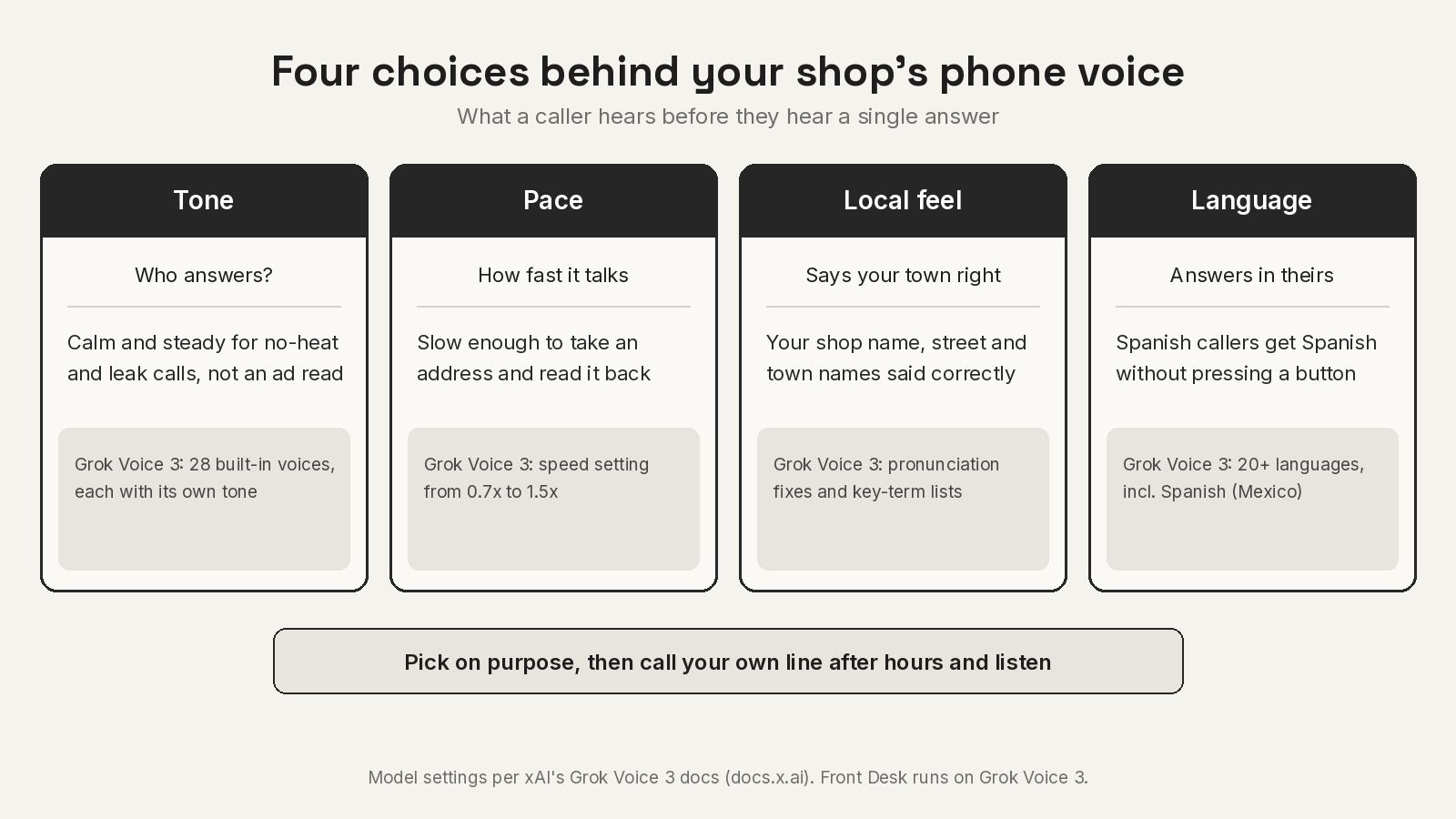
Tone, pace, local feel, and language. The gray boxes show what Grok Voice 3 offers for each, per xAI's docs.
Tone: who answers your phone?
Think about the person you'd want answering if you could hire anyone. For most HVAC, plumbing, and electrical shops, that's someone warm and steady who doesn't get rattled when the caller is upset, rather than someone upbeat and salesy.
Grok Voice 3 comes with 28 built-in voices, and xAI's voice list gives each one a tone note. Some are described as warm and friendly or compassionate and reassuring, while others are built for narration, ads, or podcast commentary. Those last ones can sound great in a demo and wrong at 2am on a no-heat call. A few of the built-in voices have British, Australian, or Indian accents, which may or may not fit a shop in Mesa.
Pace: slow enough to get the address right
The calls that matter most are the ones where the caller is stressed and reading off a street address or a callback number. A voice that talks fast feels efficient in a demo and then forces people to repeat themselves on a real call.
On Grok Voice 3, speaking speed is a setting that runs from 0.7x to 1.5x of normal, per xAI's speech-to-speech docs. Faster is rarely the answer for a service line. What you want is a pace where reading back "4417 East Baseline, unit B" sounds natural and not rushed.
Local feel: say the town right
Local feel isn't about putting on an accent. It's about saying your shop's name correctly every time, and not mangling the towns and streets your customers live on. If you serve Ahwatukee or Queen Creek, a caller notices right away when the voice trips over the name.
Grok Voice 3 handles this two ways in the same docs. A pronunciation list swaps how specific words are spoken without changing the written transcript, and a key-terms list (up to 100 terms) helps it hear names like your street names and brand correctly in the first place. Neither one is glamorous, and both do more for "sounds local" than any accent would.
Language: answer in theirs
If a real share of your callers would rather speak Spanish, the voice should answer them in Spanish without making them press 2 or wait for a callback. Grok Voice 3 lists more than 20 supported languages, including Spanish (Mexico) and Spanish (Spain), detects the language the caller is speaking, and responds in it. xAI also says every built-in voice speaks every supported language, so a bilingual caller hears the same voice in both.
If you have bilingual callers, test this on purpose. Have someone call in Spanish, switch to English halfway, and see whether the call still ends with the details right.
What about cloning your own voice?
Some owners will ask whether they can make the receptionist sound like them or like their longtime office manager. The technology exists. xAI offers custom voices cloned from a short recording of up to two minutes, currently available in the U.S. except Illinois, per its custom voices docs.
To be clear, this post isn't announcing that for Front Desk. And before any shop goes that route, it's worth thinking about whose voice it is and what happens when that person leaves. A well-chosen built-in voice that fits the shop is a fine answer for most owners.
A five-minute test you can run tonight
- Call your own line after hours, and listen like a stranger would.
- Ask yourself whether that voice sounds like someone you'd send to a customer's house.
- Read it a real address from your service area and a phone number, and check that both come back right.
- If you serve Spanish speakers, have someone call in Spanish.
- Listen for your shop's name. If it's said wrong, that's the first thing to fix.
The voice won't book the job on its own. That still comes down to whether the agent gets the details right and puts the job on the board. But it's the first thing every caller hears, so it should be a choice someone made on purpose.
Hear it for yourself
If you want to hear how Front Desk sounds on a call like yours, go to front-desk.ai or book a short demo.
- Block's Dessa sounds human. Here's what it still needs before it answers a shop's phone
- Augment the Front Desk. Don't Replace the Team.
- Front Desk now answers on Grok Voice 3. Here's what that means for your callers
- After-hours intake for personal injury firms: the 9pm call
- AI receptionist for personal injury lawyers: a 10-point checklist
- Bilingual legal intake for PI firms shouldn't wait for one person's shift
- Personal injury attorney intake: what Front Desk does for PI firms
- "Google Now Charges for Missed LSA Calls. Answer Inside 20 Seconds."
- "Personal AI Agents Are Calling the Shop. What Changes for Your Phone Line"
- Why Local Businesses Are Switching To AI Phone Agents
- What a ~$10 AI phone does for a contractor (and what it still is not)
- ElevenLabs Reception is $29. Does it get the job done?
- When a New Model Drops, Your Agent Gets Better.
- Your Front Office Is Four Logins.