Augment the Front Desk. Don't Replace the Team.

Cutting customer service representative (CSR) payroll by swapping the front desk for an artificial intelligence (AI) receptionist sounds like an easy win on paper. In practice, when the AI does not book into the same dispatch rules a human would, the missed jobs show up as missing revenue.
Jeff Conlon (@freeconlon) posted about a plumbing client that replaced front-desk dispatch with an AI receptionist to save on payroll. Conlon says that, per his claimed client figures (not independently verified), monthly revenue went from $1.16M to $814K in a single month, a drop of $346K, and the booking rate fell from 62% to 45%. His point was blunt: saving money on CSR payroll does not mean much when hundreds of thousands in revenue walk out the door.
We build Front Desk for heating, ventilation, and air conditioning (HVAC), plumbing, roofing, and electrical shops, and that story is the exact mistake we tell owners not to make. Augment the team instead of ripping out the CSR and dispatch wiring.
What went wrong in that swap
The payroll line is easy to see. The booking line is harder, because it lives in how the shop actually takes work: service area, emergency vs routine, which tech is on what truck, arrival windows, and what gets written into the field service management (FSM) system the board already runs on.
When you replace the person who knew those rules with a voice that only sounds helpful, callers still get answered, but jobs land wrong, get half-booked, or bounce. A reply to Conlon's post put it cleanly: an AI receptionist only works when it books into the same dispatch rules a CSR would. Cut payroll without that wiring and you just moved the miss elsewhere (@TeknomadHQ).
We are not claiming Conlon's numbers as our own case study. They are his claimed client figures. The pattern is what matters: replace the desk wholesale to save wages, and you can lose more on the board than you saved on the schedule.
What augmenting looks like on a real day
Picture a busy Tuesday. The CSR is already on a call with a homeowner who needs a complex multi-visit plan, while another line rings with a water heater that just quit, and the owner is out on a bid. That is not a moment to fire the CSR. It is a moment for a second seat on the phone stack.
Here is how we think about that second seat with Front Desk:
- After hours and weekends, when nobody is at the desk, the agent answers on the first ring, captures address, problem, and urgency, and books into the FSM you already run (ServiceTitan, Housecall Pro, Jobber, or your calendar).
- During the day, it takes overflow and the first ring while the CSR stays on the hard conversations, the angry callbacks, and the jobs that need judgment.
- Emergencies warm-transfer to whoever is on call, under rules you set, instead of leaving a voicemail that a flooded basement will not wait for.
- Every call gets a recording and a transcript, so the CSR and the owner can see what was promised without replaying the whole day from memory.
The CSR and dispatch stay in place, and the agent sits on the inbound phone layer and books into the same rules those humans already use.
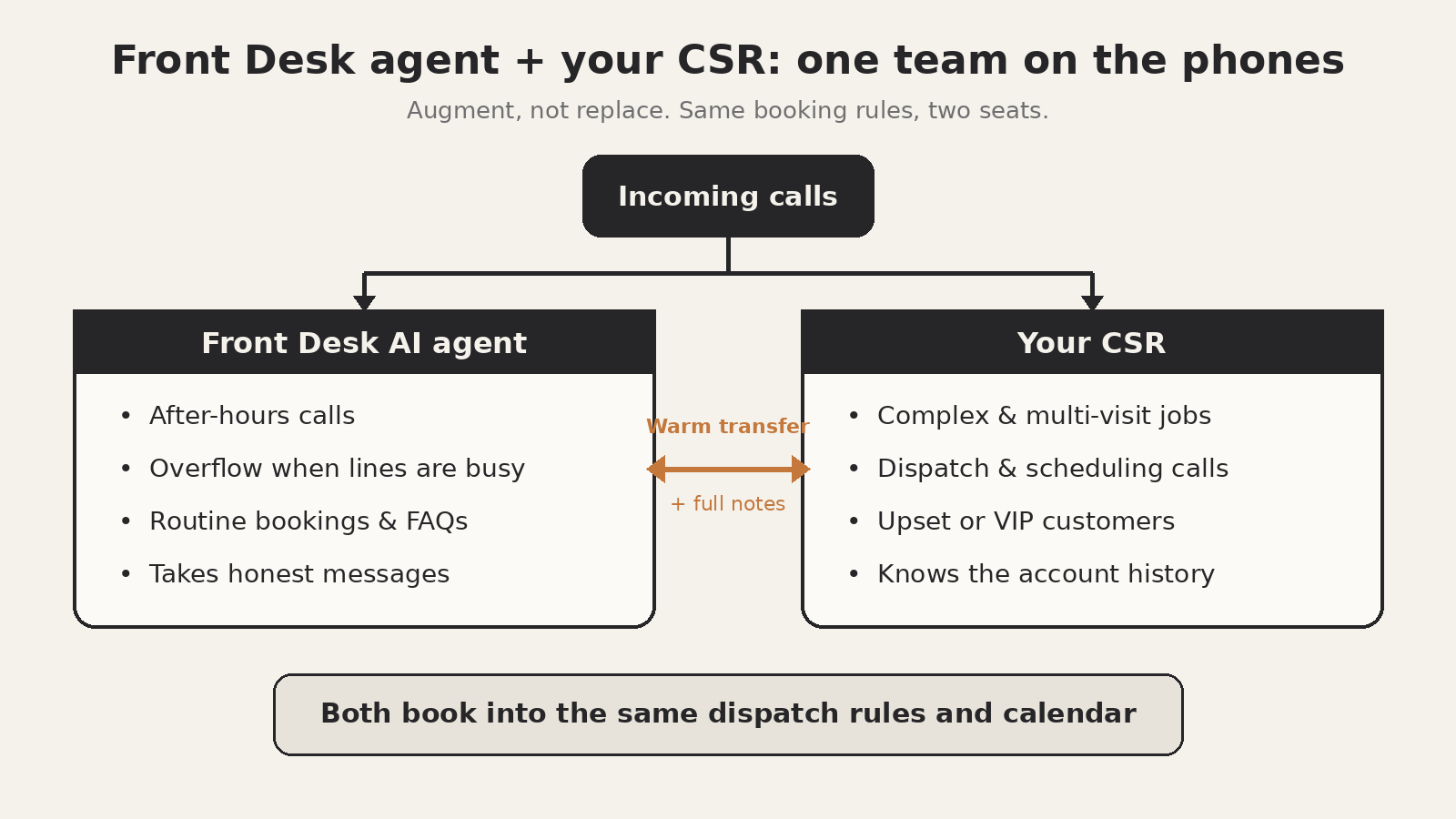
The agent covers after-hours, overflow, routine bookings, and honest messages. The CSR keeps complex jobs, dispatch, and customers who need someone who knows the account. A warm transfer or full notes connects the two, and both book into the same dispatch rules and calendar.
Why the wiring matters more than the voice
Sounding natural on the phone helps, but it is not the job. The job is still book when you can, transfer when a person should take it, take a message when that is the honest move, and refuse a bad write into the FSM. Jobs on the board beat a pretty voicemail every time.
That is why we care about the decision layer in the stack, not just the live voice. A quick gate that asks "are we in the service area?" and "do we have enough to book?" keeps the agent from inventing a job or parking junk on the board. When confidence is low on something critical, the honest move is one clarifying question or a warm transfer to the CSR who already knows the account.
If you strip that out and treat AI as a cheaper CSR with no shared rules, you get the Conlon story: answered calls, lower booking rate, and a revenue hole that payroll savings cannot fill.
What we would tell an owner considering the swap
A few checks before anyone cuts a desk role for software:
- Write down the dispatch rules the CSR actually uses (area, emergency, windows, who gets which jobs). If the AI cannot follow those, it is not ready to sit on the line alone.
- Keep a human path for complex, angry, or high-stakes calls. Augment means the agent handles volume and after-hours; the CSR keeps the hard ones.
- Measure booking rate and revenue on the board, not just wages saved. Payroll is a line item, and missed jobs are the profit and loss (P&L).
- Prefer a design where the agent writes into the FSM you already trust, with a fail-closed write when the state looks wrong.
We are not going to invent a savings number for your shop. That depends on your call volume, hours, and how often the line goes unanswered today, and you know those better than we do. What we will say is that replacing the team wholesale to cut CSR payroll is a fragile bet, and augmenting the desk so every ring can still land as a real job is the more durable one.
Soft next step
If you run a home services shop and want to see how a second seat on the phone would work next to your CSR, not instead of them, start at front-desk.ai/for/home-services. Or book a short demo and hear a call on your kind of job.
- Block's Dessa sounds human. Here's what it still needs before it answers a shop's phone
- Your Phone Voice Is the First Hello
- Front Desk now answers on Grok Voice 3. Here's what that means for your callers
- After-hours intake for personal injury firms: the 9pm call
- AI receptionist for personal injury lawyers: a 10-point checklist
- Bilingual legal intake for PI firms shouldn't wait for one person's shift
- Personal injury attorney intake: what Front Desk does for PI firms
- "Google Now Charges for Missed LSA Calls. Answer Inside 20 Seconds."
- "Personal AI Agents Are Calling the Shop. What Changes for Your Phone Line"
- Why Local Businesses Are Switching To AI Phone Agents
- What a ~$10 AI phone does for a contractor (and what it still is not)
- ElevenLabs Reception is $29. Does it get the job done?
- When a New Model Drops, Your Agent Gets Better.
- Your Front Office Is Four Logins.