When a New Model Drops, Your Agent Gets Better.
When a new model drops, your agent should get better. More human on the phone, or faster answers that cost less. That is the point.
One advantage of working with us is that we are proactive about it. You do not have to chase every release. When something real lands, we put it on your stack so the agent on your line benefits.
Here is one concrete example of how we are incorporating some of the latest models, including TypeSafe AI’s Jev, into our conversational agent stack, what it can do for you, and why that matters on a busy HVAC or home-services day.
What you actually get when we put new models on your stack
A lot of “AI phone” talk stops at sounding natural. Sounding natural helps. It is not the job.
The job on your line is still the same: book the right call when you can, transfer when a person should take it, take a message when that is the honest move, and keep junk or half-ready jobs out of ServiceTitan, Housecall Pro, or Jobber. Jobs on the board beat a pretty voicemail every time.
So the win is not “we chase models.” The win is your agent gets better on the decisions that matter. Not just the voice. The judgment behind the voice.
The concrete example: TypeSafe AI’s Jev in the phone-agent stack
Jev is a decision layer. In plain English, it is a fast helper that answers structured questions about what is going on in the call, instead of writing the conversation itself.
We are wiring it into Front Desk’s conversational agent stack now. Think of the call as three roles working together:
- The live voice model handles the ear and mouth. It listens and talks in real time.
- A heavier brain handles tools and harder shop policy when the moment needs it.
- Jev sits in the middle as the quick “what should we do next?” layer.
That middle layer matters because not every beat on a call needs the heavy brain. “Are we in the service area?” and “Do we have enough to book?” are decision moments. Burning a full heavy turn on every tiny yes/no makes the call slower and more expensive. Skipping those decisions makes the voice sound warm while it books nothing, or worse, books wrong.
Jev is how we are incorporating a latest-model approach to that gap: ask clear questions over what we already know on the call, then choose the next move with more discipline.
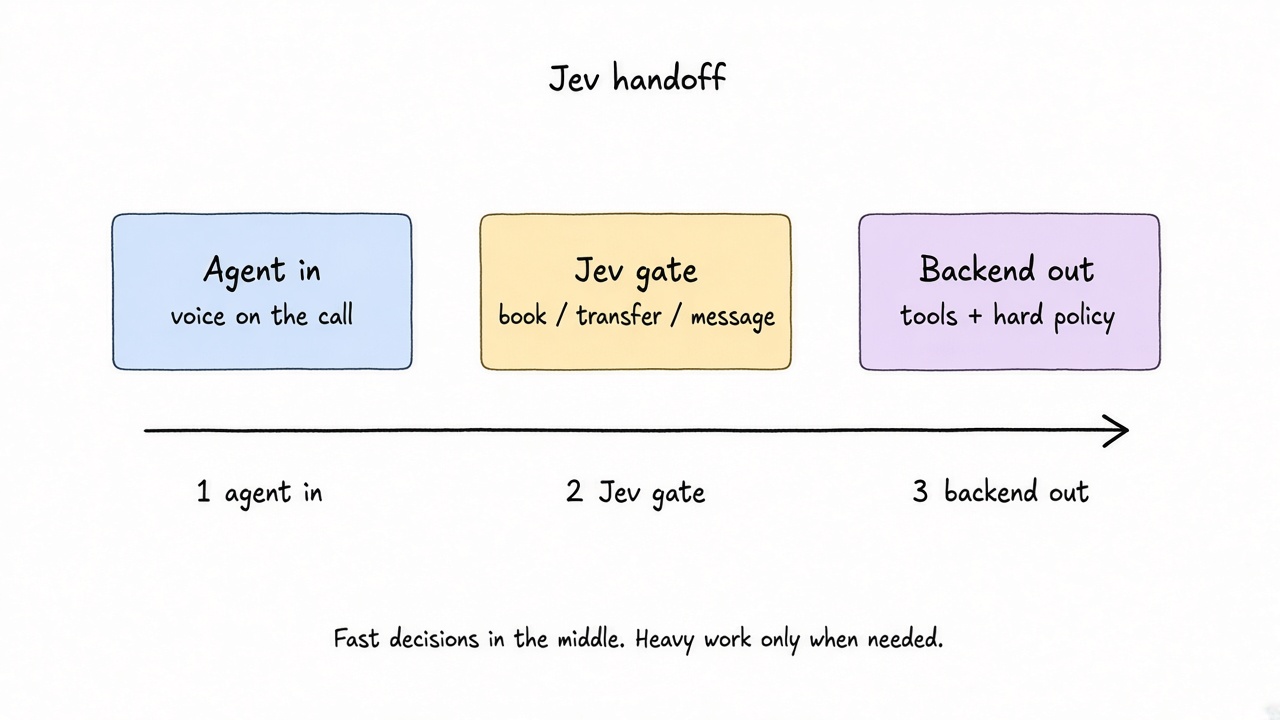
Agent in → Jev gate → backend out. Fast decisions in the middle. Heavy work only when needed.
What that means for the shop
On a real home-services call, the money path is usually one of three moves: book, transfer, or take a message.
We are putting Jev on that path so the agent can score the right move against facts you already care about: in service area, emergency or not, and whether address, issue, and callback are complete enough to book. If we are not sure on something critical, the honest move is one clarifying question or a warm transfer. Inventing a job is not a win.
There is also a safety check before anything writes into ServiceTitan, Housecall Pro, or Jobber. If the state does not support the write, or it looks unsafe (wrong tech, obvious duplicate, outside hours policy), we refuse the bad write. Fail closed. A promised callback beats a wrong job sitting on the board overnight.
And we only wake the heavier brain when the beat actually needs tools, shop policy, or booking logic. The rest of the time the live voice stays light and present. That is the edge you get when we keep up with models like this: better timing on when to think hard, and better restraint when not to.
Why this is important
Owners do not buy “models.” You buy fewer missed jobs and fewer messes in the FSM you already run.
If the phone sounds great and still drops the ball on book vs transfer vs message, you paid for theater. If it books into the wrong slot or the wrong customer, you paid for cleanup. The reason we are incorporating Jev into the conversational agent stack is to tighten those decisions while we keep the conversation human.
We are putting this in now. This is how we are wiring the stack, including a Phase A spike this week per our internal plan. It is not a claim that the full path has been live on every shop line for months, and we are not inventing rates or logos to dress it up. Honest beat: latest models in, sharper call decisions out, jobs on the board as the scoreboard.
What we are not asking Jev to do
We are not replacing the voice with Jev. We are not asking it to write scripts or sound clever. We are not shipping a “set it and forget it” button with no escalate path. When confidence is low on a critical call, clarify or transfer. That is the design.
Later we can use the same decision muscle for things like routing slots, filtering which knowledge to pull in, and overnight review of transcripts. Those are next. This piece is about the call loop that protects book vs transfer vs message.
The Front Desk edge, said simply
When the next model lands, the same rule applies. We put the useful ones on your stack so your agent gets better, whether that means more human on the phone or sharper decisions that cost less to run. TypeSafe AI’s Jev is one of those pieces: book when it should, transfer when it should, message when it should, and refuse a bad write into the systems you already trust.
If you want the home-services product picture, start here: front-desk.ai/for/home-services. To hear a live call path, use front-desk.ai/demo.
- Block's Dessa sounds human. Here's what it still needs before it answers a shop's phone
- Your Phone Voice Is the First Hello
- Augment the Front Desk. Don't Replace the Team.
- Front Desk now answers on Grok Voice 3. Here's what that means for your callers
- After-hours intake for personal injury firms: the 9pm call
- AI receptionist for personal injury lawyers: a 10-point checklist
- Bilingual legal intake for PI firms shouldn't wait for one person's shift
- Personal injury attorney intake: what Front Desk does for PI firms
- "Google Now Charges for Missed LSA Calls. Answer Inside 20 Seconds."
- "Personal AI Agents Are Calling the Shop. What Changes for Your Phone Line"
- Why Local Businesses Are Switching To AI Phone Agents
- What a ~$10 AI phone does for a contractor (and what it still is not)
- ElevenLabs Reception is $29. Does it get the job done?
- Your Front Office Is Four Logins.